Prankquean’s three visits
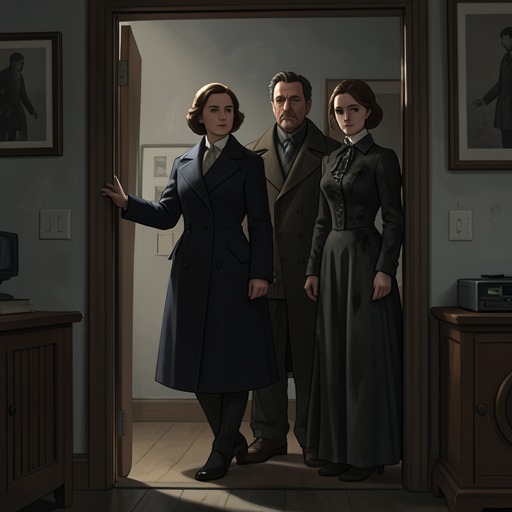
Finnegans WakePrankquean’s three visits is a folk-tale-like episode in which the Prankquean repeatedly challenges Jarl van Hoother at his stronghold and abducts one of the children in his household. Its three-part structure turns a repeated question and command into a changing contest: the Prankquean’s tally rises from one to three, while Jarl’s responses culminate in a spectacular show of force that ends the raids and converts conflict into a public peace.
A legendary household and its first challenge
The episode begins in an imagined remote past, when Adam is tilling and his “madameen” spinning water plants. Jarl van Hoother, described with the unstable grandeur of a “mulkmountynotty man,” has his head raised in his lamphouse and his cold hands upon himself. In his home, figured at once as castle and earthen house, two “little jiminies,” Tristopher and Hilary, play with a dummy on the oilcloth floor. The opening makes domestic life, legend, and wordplay inseparable: an ordinary household is already staged as a mythic stronghold. The Prankquean arrives as the only visitor at the inn’s keep. She lights a fire, makes her challenge to the dour Jarl, and asks why she appears to him like one “poss of porterpease.” Jarl answers with the curt command “Shut!” Rather than settle the encounter, his refusal prompts her to seize Tristopher and run westward. Jarl follows, pleading for her to stop and return the child, but she declares herself unlikely to do so. The first visit thus establishes the episode’s repeating pattern: a riddle, a shut-down response, an abduction, and a pursuit that fails to recover the child.
Two returns and the changing children
The tale then compresses a forty-year wandering into a transformation of Tristopher. The Prankquean washes the child’s “lovespots” with soap and sends four teachers to instruct him; she converts him toward “allgood,” and he becomes a “luderman.” She returns with him at night, carrying him in her pinafore. The elapsed years do not resolve the dispute: they bring the same visitor back to the same household, but with a changed child and a new count in her challenge. At the second visit, Jarl is again in his stronghold, now with his heels submerged in cellar malt and the children below on the floor with the dummy. The Prankquean lights up once more and asks why she looks like two “poss of porterpease.” Jarl again commands her to shut. This time she sets one child down and takes another, then runs toward Woman’s Land. Jarl pursues with a louder appeal, asking her to return with his earring; she answers that she likes what she is doing. A second forty-year journey follows. The Prankquean curses and marks the child, appoints four instructors, and changes him toward “allsecure”; he becomes a “tristian.” She returns again after a pair of seasons, bringing the child beneath her cloak. The recurrence is not exact repetition. The challenge advances from one likeness to two, Jarl’s answer remains a shutting command, and the abduction again exchanges one child for another. Meanwhile, the children’s names and destinies shift through elaborate transformations. The tale treats time as both enormous and cyclical: forty years pass in a few sentences, yet the Prankquean and Jarl meet again in recognizable roles.
The third challenge and Jarl’s counterstroke
On the third return, Jarl is in his mansion with his hips raised to the pantry box, while the children and dummy are described as being in a “second infancy.” The Prankquean asks why she resembles three “poss of porter pease.” This time the narrative marks the end of the “skirtmishes.” The increasing count has reached three, and the encounter no longer proceeds into another abduction and forty-year circuit. Jarl himself now comes out through the opened archway of his three-shuttered castle. His entrance is a parade of civic and martial costume: broad ginger hat, collar, white-hemmed clothing, gloves, breeches, bandolier, and a fur-framed garment. Presented as “Boanerges himself” and “the old terror of the dames,” he orders her to shut up shop. The Prankquean shuts the shutter with a thunderous, many-syllabled sound, and all drink freely. The decisive reversal is comic rather than violent: after two failed pursuits, Jarl’s imposing appearance and command close the encounter, while the noise of the shutter gives way to communal drinking.
Settlement and narrative significance
The ending assigns each figure a place in a newly declared settlement. The Prankquean is to keep her “dummyship,” the children are to keep the peace, and Jarl is to “git the wind up.” The formula does not erase the earlier disturbance; it absorbs it into a public order whose terms retain the tale’s playful instability. The episode’s final claim that the “burger” brings felicity to the whole “polis” elevates a household quarrel into a comic civic foundation. The repeated riddle supplies the episode with its structural clock: one, two, three visits, each answered by “Shut!” until Jarl’s final intervention makes the command effective. Yet the cycles do not return unchanged. Children are successively taken, taught, renamed, and brought back; Jarl’s responses grow from words and pursuit to a ceremonious appearance; and the third encounter ends in a shutter, a feast, and an arrangement among the participants. The story’s mock-heroic language makes abduction and domestic authority at once legendary and ridiculous, allowing a tale of repeated disruption to finish not with a simple victory but with an uneasy, celebratory peace.